CURRENT EXHIBITIONS
March 1-April 24, 2024
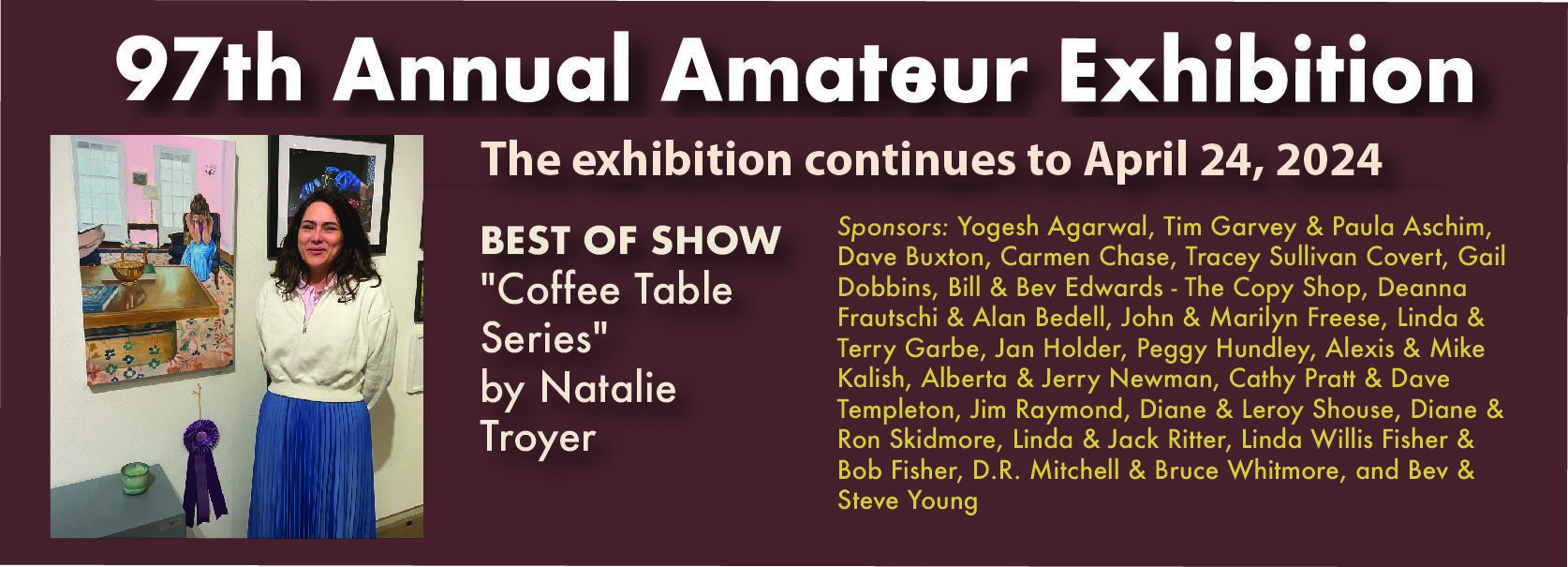
97th Annual Amateur Art Exhibition, Brandt Gallery
Congratulations to all participating Artists!
HIGH SCHOOL
Painting:
1st place: "Grandpa"s Chevy" by Hailey Warfel
2nd place: "Unspoken” by Emersyn Moore
Graphics:
1st place: "Metamorphic Butterflies" by Shreya Mokashi
2nd place: "Sugar Rush” by Ellasyn Loudenburg
Photo/new media:
1st place: "Surrounded by Sound" by Vivian Wright
2nd place: "Pressure" by Mary Doll
Sculpture:
1st place: "Horrible Flesh Cube" by Oliver Oscar Grant
2nd place: "Chunky Jewelry Set" by Rylee Mosier
COLLEGE
Painting:
1st place: "Falling Back On Nothing To Fall Back On" by Kolin Wilkins
2nd place: "Poise" by Katherine Novotny
Graphics:
1st place: "My Emotional Support Bottle of Sriracha" by Alex Cox
2nd place: "This Beautiful Fantastic" by Amy Chiappetta
Photo/new media:
1st place: "Blessing" by Jade Nguyen
2nd place: "Looking In" by Jacqueline Buehler
Sculpture:
1st place: "Artifact 01" by Ian Cooper
2nd place: "Fasciated Orchid Series" by Melanie Portnov
Video:
1st place "Leco" by James McGurk
ADULT
Painting:
1st place; "For Your Health" by Susan Holifield
2nd place: "The Morrigan" by Sean-Thomas Gunnell
Graphics:
1st place: "From the Cocoon" by Natalie Maloy
2nd place: "TT" by Meghan Roller
Photo/New media:
1st. place: "Fishing in the Congo" by Laurie Bergner
2nd place "Foggy Morn at Angler's" by Mardell Klasen
Sculpture:
1st place: "Steam Punkin" by Gina LaMonica
2nd place: "Idyllic Tower" by Vickie Fitzgerald
Fiber:
1st place: "Something So Indisputably Beautiful" by Didi Skidmore
2nd place: "Tattered Evolution" by Melanie Shellito
The Ashley Ritter Award for Most Promising Young Artist:
Kolin Wilkins
DIRECTOR’S CHOICE:
“Ketchikan” by Carl Olson
BEST OF SHOW:
"Coffee Table Series" by Natalie Troyer

| |
| |
| |
| |
| |
|
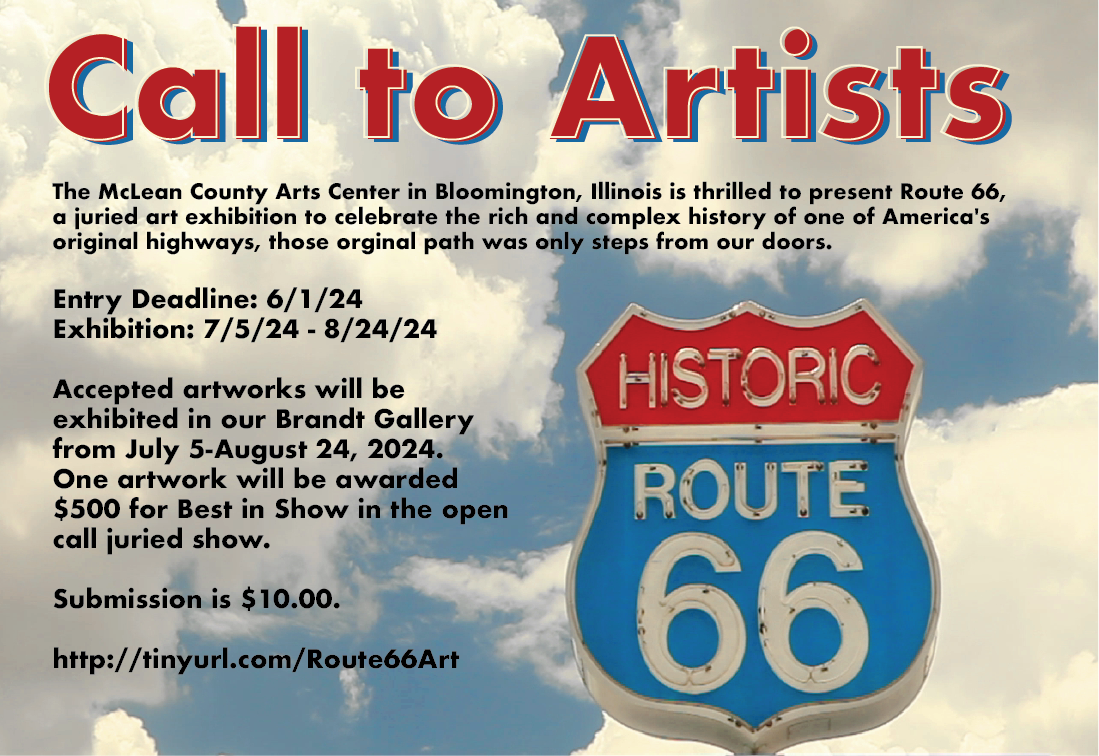
The McLean County Arts Center in Bloomington, Illinois is thrilled to present Historic Route 66 (title TBD), a juried art exhibition to celebrate the rich and complex history of one of America's original highways. U.S. Highway 66, or Route 66, was a transportation artery stretching 2400 miles that brought change and social transformation from the shores of Lake Michigan to the coast of the Pacific Ocean. This exhibition aims to take a closer look at this now-decommissioned highway's storied past, and its connections to the present. 2-D and 3-D interpretations in any media, abstract or representational, are welcomed. Accepted artworks will be exhibited in our Brandt Gallery from July 5-August 24, 2024. One artwork will be awarded $500 for Best in Show. The exhibition will be juried. Submission is $10.00.
|


Mission Statement: We encourage and promote the appreciation, study, cultivation, development, and practice of art for the benefit of all the people, cultures and communities of McLean County.
 | "This program is partially supported by a grant from the Illinois Arts Council through federal funds provided by the National Endowment for the Arts" |